
Joint preservation
Keep the joint you have, when an operation to save it is wiser than one to replace it.
- Often under an hour. — your list may differ.
- Often regional or general. Confirmed on the day.
- Many arthroscopies are day-care.
- Desk work is often discussed in days to a few weeks. Sport takes longer.
What is it?
Joint preservation means treating a joint so that replacement can be delayed or avoided. It can include physiotherapy, an injection, an arthroscopy, or a realignment procedure.
Symptoms, causes, who it may help
Symptoms
- Activity pain in a knee or hip that is not yet ‘bone on bone’.
- Swelling after sport in a younger adult.
Causes
- Early cartilage wear, a meniscus problem, or an alignment that overloads one side.
Who it may help
- People with symptoms and a joint that still has something to save.
How it is assessed
- exam
- Alignment, gait, and the specific tender point.
- xray
- Standing views to see the joint space.
- mri
- When cartilage or meniscus detail will change the plan.
- clinic
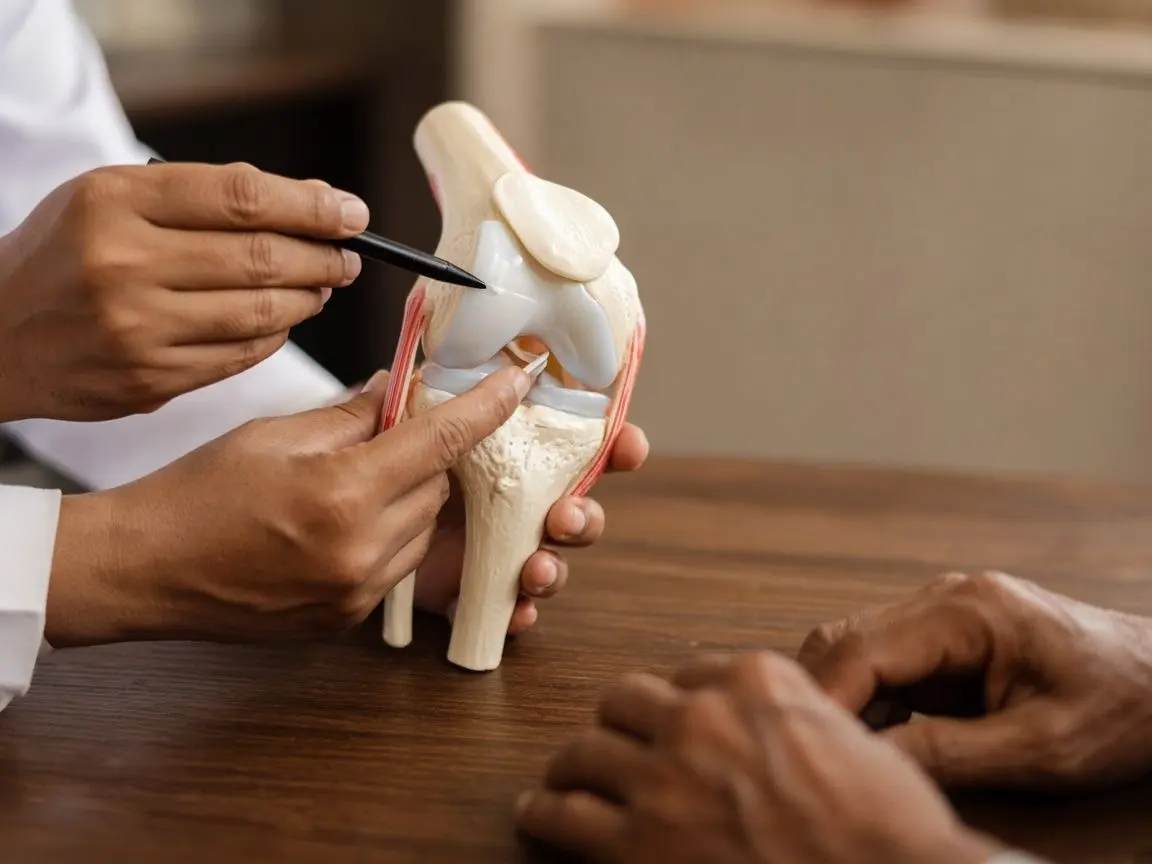
- The models on the desk are there for this conversation.
Treatment options
| Option | Without surgery | With surgery |
|---|---|---|
| Often the treatment, not the warm-up. | No operation. | |
| Strength and a change in training load. | ||
| An injection may be one step. | A camera only if it will treat a mechanical problem. | |
| Discussed when one side of the knee is overloaded. | A realignment operation, only if it suits your knee. | |
The procedure, step by step
- 01
Map the wear
Examination and standing X-ray.
- 02
Try the non-surgical plan
A real block of physiotherapy, not a token week.
- 03
Reassess
If life is acceptable, stop. If not, talk about the next step honestly.
- 04
Preserve or replace
Replacement is the other door, not a failure of preservation.
Recovery roadmap
You can: This path often has no operation on day 1. Follow the exercise sheet.
Avoid: Twisting the operated leg. Walking without the aid you were given.
Do, do not, and when to call
Do
- Train the muscle above the joint.
- Ask what ‘success’ means for your joint before you agree to an operation.
Do not
- Do not take an injection the week of an important match without a plan.
Call the clinic
- Fever, a wound that opens, or pus.
- Calf pain and swelling, chest pain, or sudden breathlessness.
- A leg or arm that becomes numb, cold, or impossible to move.
- Pain that is far beyond the plan you were given.
Risks and honest expectations
- Infection, bleeding, clots, stiffness, and anaesthesia reactions are possible with any operation.
- A good result still needs physiotherapy. The operation is one part of the recovery.
- Preservation can fail and a replacement may still be needed later. That possibility is part of the consent.
The win is a joint that works for your life for longer. It is not a guarantee that replacement never happens.
See it
At the clinic
Consultation room 1.
Questions
No. Preservation tries to avoid or delay replacement. If the joint is already destroyed, replacement is the clearer operation.