Knee arthroscopy
A camera inside the knee, through small openings, when the joint itself needs to be seen or treated.
- Often under an hour. — your list may differ.
- Often regional or general. Confirmed on the day.
- Many arthroscopies are day-care.
- Desk work is often discussed in days to a few weeks. Sport takes longer.
What is it?
Knee arthroscopy uses a camera and fine tools through small portals. It is how ligament and meniscus work is done, and how some loose bodies or cartilage problems are treated. It is not a treatment for every painful arthritic knee.
Symptoms, causes, who it may help
Symptoms
- Locking, catching, or a story that does not match a simple sprain.
- Swelling that keeps returning.
Causes
- Meniscus tear, ligament injury, loose body, or a cartilage flap.
Who it may help
- People with a mechanical symptom and a scan that agrees.
How it is assessed
- exam
- The knee is examined before any offer of a ‘scope’.
- xray
- Rules out fracture and shows arthritis.
- mri
- Often the scan that decides if a camera will change anything.
- clinic
- Digital X-ray is on site. The procedure itself is not done in the consultation room.
Treatment options
| Option | Without surgery | With surgery |
|---|---|---|
| Rest, physiotherapy, and time for sprains and many wear-and-tear pains. | No camera. | |
| Used when seeing or treating the inside of the joint is likely to help. | Camera and instruments through small portals. | |
The procedure, step by step
- 01
Anaesthesia
Regional or general.
- 02
Camera
The joint is filled with fluid and inspected in a set order.
- 03
Treat
Only the planned problem, plus anything unsafe that is found.
- 04
Dress and move
Small dressings. Movement usually starts the same day.
Recovery roadmap
You can: Walk as advised, often with support.
Avoid: Soaking the dressings.
Do, do not, and when to call
Do
- Elevate and ice on day one.
- Move the knee as the paper says.
Do not
- Do not treat a scope as a smaller version of a knee replacement. The reasons are different.
Call the clinic
- Fever, a wound that opens, or pus.
- Calf pain and swelling, chest pain, or sudden breathlessness.
- A leg or arm that becomes numb, cold, or impossible to move.
- Pain that is far beyond the plan you were given.
Risks and honest expectations
- Infection, bleeding, clots, stiffness, and anaesthesia reactions are possible with any operation.
- A good result still needs physiotherapy. The operation is one part of the recovery.
- Stiffness, clot, infection, and nerve irritation around the portals are uncommon but real.
You should know, before the day, what the camera is going in to do.
See it
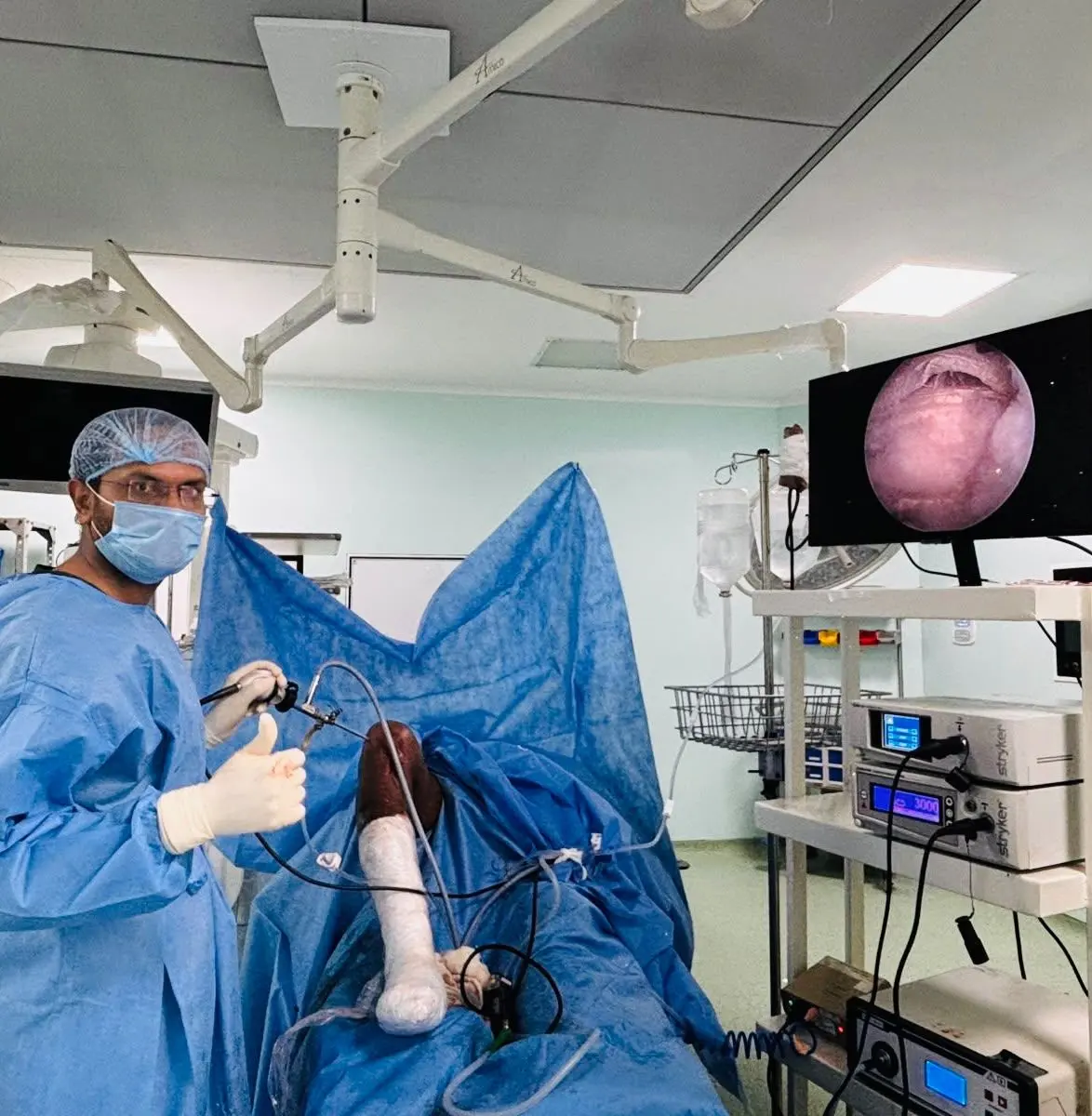
Knee arthroscopy in the operating theatre.
Arthroscopy, with the inside of the joint on the monitor.
In the operating theatre.
Questions
Usually no, if the only problem is wear. Replacement or non-surgical care is the honest conversation.