ACL and ligament reconstruction
A knee that gives way, rebuilt so a return to sport can be planned rather than hoped for.
- Often about 1–2 hours when other structures are involved.
- Usually regional or general.
- Often day-care or one night.
- Running is a later stage. Match play is often many months away.
What is it?
The ACL is a ligament inside the knee that stops the shin from sliding forward. When it tears, the knee can buckle. Reconstruction uses a graft, placed through arthroscopy, to stand in for the torn ligament. PCL and multiligament injuries are treated in the same way, with the graft chosen for your knee.
Symptoms, causes, who it may help
Symptoms
- A pop and swelling at the injury, then a knee that gives way.
- Fear of cutting, landing, or coming downstairs.
- Repeated swelling after sport.
Causes
- A twist in football, kabaddi, badminton, or a fall.
- The meniscus or another ligament may tear in the same moment.
Who it may help
- Active people whose knee is unstable, and some whose work cannot accept giving way.
- A swollen, stiff knee is often calmed before surgery.
How it is assessed
- exam
- Lachman and pivot tests, plus a look at the whole limb.
- xray
- X-ray looks for a fracture. It does not show the ACL itself.
- mri
- MRI is the usual scan to confirm the ligament and the meniscus. It can be done at any scan centre convenient for you.
- clinic
- Bring the MRI films. The plan names the sport you want to return to.
Treatment options
| Option | Without surgery | With surgery |
|---|---|---|
| Some knees cope with strength work and a change in sport. | No graft. | |
| More often discussed for lower-demand knees. | ||
| Physiotherapy still starts before surgery. | A graft replaces the torn ACL. Meniscus repair is done in the same sitting when it is needed. | |
The procedure, step by step
- 01
Settle the knee
Swelling down, full or near-full bend, and a strong quadriceps before the date.
- 02
Graft
The graft chosen for your knee is prepared.
- 03
Tunnels and fixation
Through small portals the graft is seated and fixed. Other damage is treated in the same view.
- 04
Brace and bend
A brace and a bending plan start early. The exact angles are written for you.
Recovery roadmap
You can: Home with crutches, ice, and ankle pumps.
Avoid: Walking without the crutches you were given.
Do, do not, and when to call
Do
- Ice and elevate in the first days.
- Hit the bending numbers you are given.
- Name your sport so the end tests match it.
Do not
- Do not return because the knee ‘feels fine’.
- Do not skip physiotherapy in month two.
Call the clinic
- Fever, a wound that opens, or pus.
- Calf pain and swelling, chest pain, or sudden breathlessness.
- A leg or arm that becomes numb, cold, or impossible to move.
- Pain that is far beyond the plan you were given.
Risks and honest expectations
- Infection, bleeding, clots, stiffness, and anaesthesia reactions are possible with any operation.
- A good result still needs physiotherapy. The operation is one part of the recovery.
- The graft can stretch or retear. Stiffness and kneeling pain can follow.
Stability for pivoting sport is the aim. The calendar is individual. No return-to-play percentage is published here.
See it
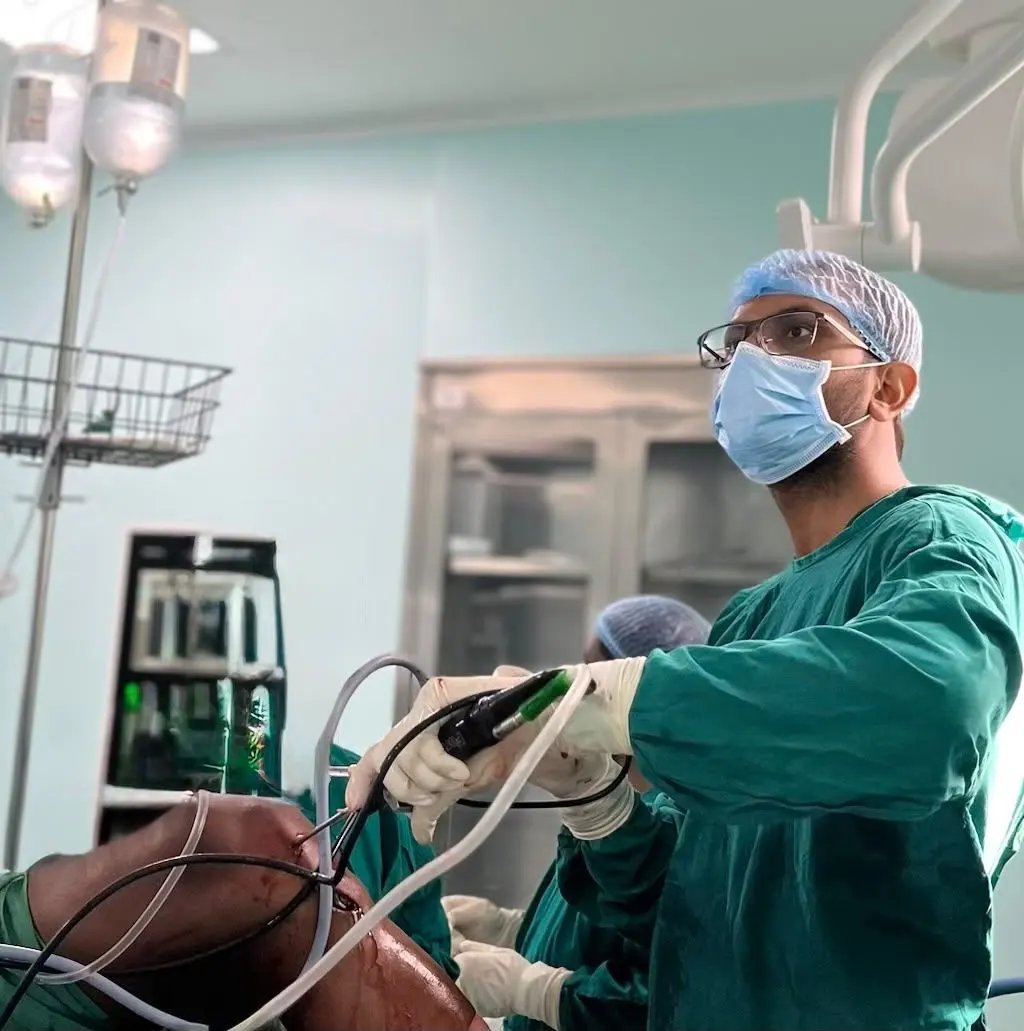
Knee arthroscopy in the operating theatre.
Arthroscopy, with the inside of the joint on the monitor.
Questions
Repair is a different operation for selected tears. Which option suits your knee is decided after the examination and MRI.